Eugene Onegin
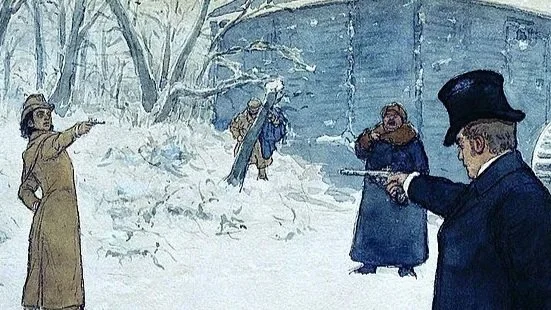
Image: Yevgeny Onegin by Ilya Repin, 1899
To round off their 2024/2025season, the Canadian Opera Company wowed audiences with a new production of Tchaikovsky’s famous “Eugene Onegin”.
The Canadian Opera Company tends to lean visually, with the exception of “Wozzeck”, towards a more minimalist set design. “Eugene Onegin” followed suit to great and medium effect while we were transported to imperial Russia. The start of the show was a visual feast for the eyes. In the first scene we got a stage carpeted in fall leaves, and a handful of birch trees. The vibrant colours, and the dynamic nature of the leaves swishing underfoot was visually wonderful.
While it was a colourful symphony, to perhaps even greater visual storytelling success was the depth of field it allowed. When Onegin and Tatyana were being acquainted at the front of the scene, and Olga and Lensky were at the back of the stage playing in the leaves, falling in love, it provided such an amazing amount of immersion. Even though Olga and Lensky were not singing, the visual message spoke strongly to the development of their relationship. Very effective story telling.
The set design continued in its intrigue with the use of light for Tatyana’s room to establish the walls in the leaves; skillful lighting design without disturbing the foliage.
However, the second act fell visually a little flat once the leaves were gone, and the set became incredibly minimal. In terms of story telling mechanism, it appropriately shifted the tone of the story, out from the rural fields of the country estates into the sterile cold environment of aristocratic St. Petersburg. The costume design was wonderful: ballgowns, tailcoats, and gems, really contrasted the simple clothes of the lower class. And while the plain white set walls with furniture creating the limits of the space gave a sense of restriction, and made the aristocrats crowd each other—a clever interpretation of high society—but it visually hit just left of the mark as things were too cramped. The second act set design had layers to it’s styling, but did feel visually overwhelming, or underwhelming at different times.
In terms of the music, under conductor Speranza Scappucci, Lauren Fagan played Tatyana and was beautiful in their role. She did well in telling the story of youthful naiveté, growing to maturity and standing up for oneself. Fagan’s rendition of “Puskai pogibnu ya” (“Let me perish”) was passionate and sincere. Her acting matched the tone of her character, she did an impressive job.
Eugene was stoic and commanding, played by Andril Kymach. His baritone voice matched his noble status, and his descent into desperation to get Tatyana back was convincing and well performed.
Of course everyone did well, the Canadian Opera Company always gets the best of the best. However, from this production of Eugene Onegin, there were two standouts we saw: Olga and Letzy. Played by Megan Marino and Evan LeRoy Johnson, respectively, they both sang to impress.
Megan Marino had such a wonderful energy about her. Marino brought life to the character and made Olga’s love for Lensky present in each phrase. Of exceptional note, Marino’s low range was rich and strong. Tchaikovsky had her sing low multiple times, each time with ease. Brava to Marino.
Lensky, sung by Evan LeRoy Johnson, was the vocal star of the show. Johnson’s voice was strong and emotionally brilliant. The honey sweetness behind his performance touched the heart of everyone in attendance. Johnson’s phrasing and expression gave sweet tenderness to Lensky’s love, or lament, of those in his life and was heartbreakingly beautiful. Johnson is on the Abstracto Montier ‘hope to hear again’ list for sure.
The penultimate production of the Canadian Opera Company’s season was a success, that is for sure. With an ambitious season coming in the fall, we only have more to look forward to.