‘A Requiem for the Living’, Brahms Requiem
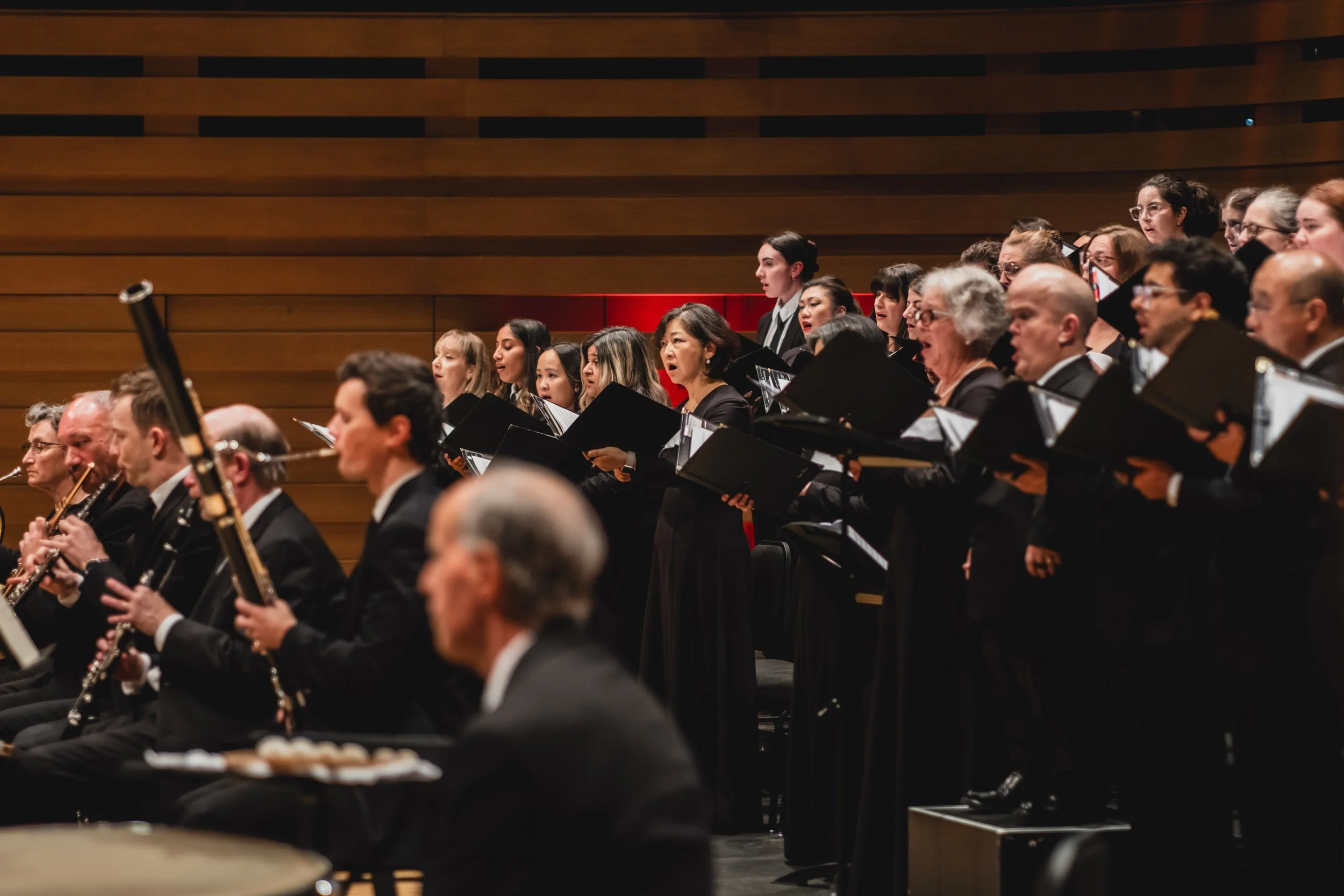
Image provided by Toronto Mendelssohn Choir, Photo credit Jae Yang.
A ‘Reqiuem for the Living’ is an apt performance for a world caught in tempestuous circumstances. Brahms wrote this work after the death of his mother, yet it provided, and continues to provide, a cathartic balm to any who are dealing with lose or the heartache of the world. This past Friday, Toronto Mendelssohn choir, with members of the Kitchener-Waterloo Symphony Orchestra, sang to the city at Koerner Hall this canonical grand work, along with a new commission.
The evening began with a new work: “Echo”, composed by Stephanie Martin. Written as a companion piece to the Requiem, the theme of memory and pondering were largely present in the new work. The orchestration was lush, with Martin not being afraid to use the low string voices, which provided a beautiful colour. “Echo” thinking of memories of times or peoples past, felt like one was sifting through the fog of recalled consciousness. Not sure where to put your foot down in the spacious and slightly ambiguous harmony, but never lost within the key as you are in the familiar territory of your own mind.
The work was beautiful, and Martin’s use of the secondary voices up in the balcony to literally be a soft echo was a very skilled decision. The harmonic structure, the singing in Latin, and use of the separate voices felt very high Anglican tradition, with the ideas reminiscent of the works by Ralph Vaughn Williams, with “Variations on a Theme by Thomas Tallis” as the predominant piece coming to our minds. Brava to Stephanie Martin!
When it came to the Brahms, the choir was quite strong with dynamic control, which is increasingly impressive given its large size. Brahm’s requires a lot of the choir, with a range of emotion, dynamics, drama and precision. Their control of dynamics was especially effective in the very contemplative moments, like in movement IV “Wie lielich sind diene Wohnungen” which is incredibly lyrical and has one of the most beautiful dissonant crunches in all of choral music. Their technique made for such a powerful moment.
The choir’s technical precision is to be noted also, with lots of very high sections for the sopranos which were always well supported and secured, and with some contrasting counterpoint in all the voices, they were always together and well executed.
The requiem soloists were both skilled and effective. The soprano, Charlotte Siegel was powerful, her voice filled the whole hall in moments. The power she had was astonishing, no surprise a graduate of the Canadian Opera Company’s Ensemble Studio, as her voice is fit for the opera without a doubt.
Russel Braun, baritone, was passionate and emotive. His voice is so lovely, and his lyrical qualities and phrasing were a perfect match for the Brahms more comforting characteristics.
Programming is a tough job, but I think this piece is a very apt choice for the world’s state of affairs. Each time the news is on a new set of difficulties is presented to us, and in our collective grief we are comforted by the arts, and each other. The performance of this ‘requiem for the living’ was perhaps a performance we did not realize we needed as much as we did.